
AI guardrails are the controls that decide what an enterprise AI system can accept, access, do, and say. This guide explains how they work across LLM apps, RAG, and AI agents, what the research says they can and can’t stop, and how to assemble them into a defense-in-depth architecture.
A language model cannot currently be made reliably immune to manipulation, so enterprise guardrail design should assume the model will sometimes be compromised and should limit what a compromised model can do.
Introduction
Enterprises rarely deploy “a model.” They deploy systems. A model sits inside an application that pulls in documents, reads email, queries databases, calls APIs, and increasingly takes actions on someone’s behalf. Every one of those connections changes what can go wrong.
The standard enterprise response is to add “AI guardrails.” The term is now used for everything from a system-prompt instruction (“do not reveal confidential information”) to a fine-tuned safety classifier to a human approval step before an agent wires money. That breadth is a problem. When one word covers controls with very different strength, teams overestimate how protected they are.
This guide gives AI guardrails a precise meaning. It explains how different kinds of guardrails actually work and synthesizes what the research literature shows about their effectiveness and their failure modes. It then lays out a practical enterprise architecture. The central argument is simple, but it has consequences: a language model cannot currently be made reliably immune to manipulation, so enterprise guardrail design should assume that the model will sometimes be compromised and should limit what a compromised model can do.
What Are AI Guardrails?
An AI guardrail is a control that constrains what an AI system accepts as input, what data and context it can access, what actions it can take, and what it can emit as output, according to an explicit policy. Most guardrails are enforced at runtime, and all of them depend on ongoing testing and monitoring to stay effective.
AI guardrails can be implemented as:
- Model behavior controls: safety training, refusal behavior, and instruction-priority training built into the model itself.
- Probabilistic runtime controls: classifiers, LLM-based judges, and prompt-engineering defenses that estimate whether something is unsafe.
- Deterministic runtime controls: authorization checks, schema validation, allow-lists, sandboxes, rate limits, and egress rules that enforce a rule regardless of what the model “thinks.”
- Procedural controls: human approval, review queues, incident response, and change management.
The distinction between probabilistic and deterministic controls is the single most useful idea in this article, and it recurs throughout.
How guardrails relate to adjacent terms
These terms overlap, but they aren’t interchangeable:
| Term | What it primarily concerns | Relationship to guardrails |
|---|---|---|
| AI safety | Preventing AI systems from causing harm, including harmful content, dangerous capabilities, and unintended behavior | Guardrails are one way to implement safety objectives at runtime |
| AI security | Protecting AI systems and the data and systems they touch from adversaries | Many guardrails are security controls, but AI security also covers supply chain, infrastructure, and model theft |
| LLM security | The security subset specific to LLM applications, such as prompt injection, data leakage, and insecure output handling | Most “LLM guardrails” products sit here |
| Content moderation | Classifying text, images, and other content against a harm policy | One category of guardrail (input/output filtering), not the whole discipline |
| Model alignment | Training a model’s dispositions to match intended values and instructions | Happens at training time. Guardrails enforce policy at runtime, often because alignment is imperfect |
| AI governance | Organizational accountability: policies, roles, risk acceptance, documentation, compliance | Governance decides what guardrails must enforce and who owns the residual risk |
A useful shorthand: governance sets the policy, guardrails enforce it, and evaluation and monitoring check whether enforcement actually works.
Why Enterprise AI Needs Guardrails
Why traditional application security controls are insufficient
Traditional application security relies on a clean separation between code, which is trusted and written by developers, and data, which is untrusted and supplied by users. Parameterized SQL queries, output encoding, and input validation all work because the system can tell the two apart.
LLMs erase that separation. Everything the model sees becomes one stream of tokens: the developer’s system prompt, the user’s request, a retrieved document, a tool’s output. Hines et al. (Microsoft, 2024) put it directly: the model cannot distinguish code from data. Instructions hidden in a document can be treated with the same authority as instructions from the developer. This is a structural property of current architectures, not a bug in a particular model.
Three further differences matter for enterprises:
- Non-determinism. The same input can produce different outputs. A control that works on a test prompt may not work on the next sample. Yao et al. (2024) introduced the pass^k metric in τ-bench to capture exactly this. A strong function-calling model completed fewer than half the tasks, and its consistency across eight repeated trials fell below 25% in the retail domain.
- Natural-language attack surface. Attacks can be phrased in endless ways, in any language, encoding, or format. Signature-based filtering, the backbone of traditional web application firewalls, generalizes poorly.
- Delegated authority. When an LLM calls tools, it acts with someone’s credentials. A manipulated model becomes a “confused deputy,” a legitimate principal tricked into misusing its authority.
What AI guardrails protect against in business terms
AI guardrails exist to prevent or contain concrete business harms: disclosure of confidential or regulated data, unauthorized transactions or record changes, harmful or defamatory output reaching customers, decisions based on fabricated information, runaway cost, and regulatory non-compliance. The technical taxonomy that follows is useful only insofar as it maps back to these harms.
The Enterprise AI Risk Landscape
The reference taxonomies
Two OWASP lists have become the shared vocabulary for enterprise AI application risk.
The OWASP Top 10 for LLM Applications released its current edition in August 2026. The 2026 list is: LLM01 Prompt Injection, LLM02 Sensitive Information Disclosure, LLM03 Excessive Agency, LLM04 Supply Chain, LLM05 Data and Model Poisoning, LLM06 Unbounded Consumption, LLM07 Misinformation, LLM08 Hidden Context Exposure, LLM09 Vector and Embedding Weaknesses, and LLM10 Improper Output Handling. Compared with the 2025 edition, excessive agency moved sharply up the ranking, from sixth to third.
The 2025 “System Prompt Leakage” entry no longer appears under that name, and a “Hidden Context Exposure” entry appears instead; readers should consult the 2026 text for its exact scope. The editors frame the edition around a design philosophy worth adopting wholesale: instead of trying to build a model that cannot be fooled, harden the application architecture around it so that a compromised model’s downstream impact is contained.
The OWASP Top 10 for Agentic Applications addresses risks that emerge once a model can plan, act, and remember. It was published by the OWASP GenAI Security Project on 9 December 2025, with identifiers ASI01 through ASI10. The list covers categories such as agent goal hijack via malicious content in emails, PDFs, or web pages; tool misuse through manipulated inputs; identity and privilege abuse leading to confused-deputy attacks; and compromised tools, plugins, and MCP servers fetched at runtime. It also introduces the principle of least agency, which extends least privilege to autonomous systems: give agents only the minimum autonomy needed for safe, bounded tasks.
On the government side, NIST AI 100-2 E2025 (March 2025) provides the adversarial ML taxonomy. For generative AI, it covers supply chain attacks, direct and indirect prompt injection, misuse violations, and the security of AI agents, and it pairs each attack category with mitigations and an assessment of their limitations. MITRE ATLAS catalogs adversary tactics and techniques against AI systems in an ATT&CK-style format and is useful for threat modeling and red-team scoping.
Key threat classes, precisely distinguished
Prompt injection vs. jailbreaks. The two are often conflated, but they differ in who the attacker is and what they want.
- A jailbreak is an attempt, usually by the user, to get the model to violate its safety policy, for example by producing prohibited content. The user is the adversary.
- A prompt injection is an attempt to override the application’s instructions. Direct prompt injection comes through the user interface. Indirect prompt injection (sometimes abbreviated XPIA) hides instructions in content the system processes: a web page, an email, a document, a tool result. With indirect injection the user is typically an innocent bystander, and the attacker’s instructions run with the user’s session and credentials.
Hines et al. make an observation with important enterprise implications. The same text can be benign in one channel and an attack in another. “Please transfer fifty dollars to account 54321” is a reasonable user request, but it is an attack if it appears inside an email the assistant is summarizing. Content-based filtering therefore can’t solve indirect injection on its own. Provenance matters as much as content.
Jailbreak techniques in the research literature illustrate why static defenses age quickly:
- Optimization-based suffixes (GCG) append machine-generated character strings that induce compliance.
- Automated semantic attacks use an attacker LLM to iteratively refine prompts. Tree of Attacks with Pruning (TAP; Mehrotra et al., NeurIPS 2024) jailbroke GPT-4-Turbo and GPT-4o for over 80% of prompts in its evaluation using black-box access only, and it also defeated targets protected by LlamaGuard.
- Many-shot jailbreaking exploits long context windows by stuffing the prompt with fabricated dialogues in which an assistant complies with harmful requests. Anthropic’s 2024 research found that the attack often works with shorter prompts on larger models, consistent with larger models being better in-context learners.
Sensitive information disclosure includes leakage of PII, credentials, confidential documents, or system prompts, through the model’s outputs, through logs, or through retrieval that ignores the user’s permissions. TrustLLM (Huang, Sun et al., 2024) found that models’ handling of private information varies widely, and that some models leaked information when tested on the Enron email dataset.
Hallucination vs. misinformation. Hallucination (NIST calls it confabulation in AI 600-1) is the model generating plausible but unsupported content. It is an intrinsic failure mode, and no adversary is required. Misinformation, as OWASP uses the term, is the broader risk of false information reaching users and decisions, whether it originates from hallucination, poisoned sources, or manipulation. Guardrails for the first focus on grounding and verification. Guardrails for the second also require source integrity.
Improper output handling is a classic injection vulnerability in a new place. It happens when model output is passed unsanitized to a browser, shell, SQL engine, or template renderer. The model becomes the delivery mechanism for XSS, SQL injection, or remote code execution.
Unbounded consumption covers denial-of-service and “denial-of-wallet” attacks that exploit per-token pricing, recursive agent loops, or expensive tool calls.
Poisoning and supply chain attacks corrupt training data, fine-tuning data, RAG corpora, model files, or third-party tools such as MCP servers before the system ever runs.
How AI Guardrails Work
The enforcement points
A guardrail can intervene at five points in an AI interaction:
- Before inference (pre-inference): on the user’s input and on everything assembled into the model’s context.
- During inference: through the model’s own trained behavior, or through constrained decoding that restricts which tokens can be generated.
- At the action boundary: when the model proposes a tool call or other side effect.
- After inference (post-inference): on the generated output before it reaches a user or downstream system.
- Out of band: through monitoring, logging, anomaly detection, and human review that happen alongside or after the interaction.
Four mechanism families
1. Classifiers and detectors. A separate model scores inputs or outputs for categories such as toxicity, prompt injection, PII, or topic. These can be small encoder models or full LLMs used as judges. ShieldGemma (Google, 2024) is an instructive example: a family of 2B, 9B, and 27B safety classifiers built on Gemma 2 that output a probability of policy violation per harm type rather than a binary verdict.
The authors argue this matters because it lets deployers set thresholds for their own use case. They also explicitly caution that the models may be overly conservative and that thresholds should be tuned per deployment. The range of model sizes also reflects a real trade-off: small models suit latency-sensitive inline filtering, while larger ones suit offline evaluation.
2. Prompt- and context-level defenses. These restructure what the model sees so it is less likely to follow injected instructions. Spotlighting (Hines et al., 2024) is the clearest studied example (see the RAG section). Few-shot examples of resisting attacks also fall here, though the Spotlighting authors warn that such examples reflect only known attack patterns and can leak into test sets, inflating measured effectiveness.
3. Model-level training. Safety fine-tuning and preference training shape refusal behavior. The instruction hierarchy (Wallace et al., OpenAI, 2024) trains a model to prioritize system messages over user messages over tool outputs. It teaches the model to follow lower-priority instructions that are aligned with higher-priority ones and to ignore misaligned ones. The authors reported a 63% improvement in resisting system-prompt extraction and over 30% improvement in jailbreak robustness, including on attack types not seen in training, along with some regressions in over-refusal. This is the model-level analog of what Spotlighting attempts through prompting.
4. Deterministic enforcement. These are ordinary software controls placed around the model: authentication and authorization, allow-listed tools, JSON-schema validation of tool arguments, constrained decoding to a grammar, sandboxed code execution, network egress restrictions, rate and spend limits, and required human approval. They don’t “understand” content, but they don’t fail probabilistically either.
- Classifiers and detectors
- LLM judges
- Prompt-level defenses
- Safety training
- Authorization and allow-lists
- Schema validation
- Sandboxes and egress rules
- Rate/spend limits, human approval
Why the distinction between probabilistic and deterministic controls matters
Probabilistic controls, including classifiers, LLM judges, prompt defenses, and safety training, reduce the likelihood of a bad outcome. Deterministic controls bound its impact. Research consistently shows that probabilistic controls can be defeated by a sufficiently motivated adaptive attacker (see “Common AI Guardrail Failure Modes” below). Enterprise architecture should therefore place deterministic controls at every point of consequence, meaning wherever data leaves a trust boundary or a side effect occurs, and use probabilistic controls to reduce noise and catch what deterministic rules can’t express.
Types of AI Guardrails
Preventive, detective, and corrective
| Function | Purpose | Examples | Typical limitation |
|---|---|---|---|
| Preventive | Stop a harmful event before it happens | Input filtering, authorization checks, tool allow-lists, sandboxing, output blocking, human approval gates | Blocks legitimate use when miscalibrated; bypassable if probabilistic |
| Detective | Identify that something harmful happened or is being attempted | Logging, anomaly detection, LLM-judge audits of transcripts, canary tokens in sensitive data, drift monitoring | Detection after the fact doesn’t undo an executed action |
| Corrective | Limit damage and restore a safe state | Output rewriting or redaction, session termination, credential revocation, transaction rollback, model or prompt rollback, incident response | Only as good as reversibility; many real-world actions (sent emails, payments) aren’t cleanly reversible |
A practical design rule follows from the last row. The less reversible an action is, the more its controls must be preventive and deterministic. Summarizing a document can rely on detective controls. Wiring funds can’t.
By layer
| Layer | What it controls | Example guardrails |
|---|---|---|
| Input | What enters the system from users | Injection and jailbreak detection, topic scoping, PII detection, length and format limits |
| Context | What enters the model’s context from other sources | Permission-aware retrieval, provenance tagging, spotlighting, content sanitization, document trust scoring |
| Model | How the model itself behaves | Model selection, safety training, instruction hierarchy, system-prompt design, constrained decoding |
| Tool / action | What the system can do | Tool allow-lists, per-call authorization, argument validation, sandboxes, approval gates, spend limits |
| Output | What leaves the system | Moderation, DLP and PII redaction, schema validation, grounding and citation checks, output encoding |
| Runtime | Behavior over time and across sessions | Rate limits, token budgets, loop detection, anomaly detection, tracing |
AI Guardrails Across the Enterprise Stack
AI guardrails aren’t only an application-layer concern. A defensible deployment distributes controls across six domains, and each has different owners:
- Model behavior controls (owned by the model provider and AI/ML team): model choice, safety evaluations, fine-tuning, instruction-hierarchy support.
- Application-level controls (owned by the product engineering team): prompt and context construction, input/output filters, output handling, tool orchestration logic.
- Identity and access controls (owned by IAM and security teams): user authentication, agent identities, delegated authorization, scoped tokens.
- Data controls (owned by data governance): classification, access control lists propagated into retrieval, retention, redaction, lineage.
- Infrastructure and security controls (owned by platform and security teams): network segmentation, sandboxing, secrets management, API gateways, egress policy, supply-chain verification.
- Governance and operational controls (owned by risk, compliance, and operations): use-case approval, policy definition, evaluation gates, monitoring, incident response, audit.
When AI guardrails are treated as a single product purchased by one team, the domains that team doesn’t own tend to get neglected. Identity and data controls are the most commonly neglected, and they are often the most important.
AI Guardrails for LLM Applications
For a chat-style application without tools (a customer FAQ bot, a drafting assistant), the risk profile centers on harmful or off-policy output, data disclosure, jailbreaks, and misinformation.
Input guardrails typically combine:
- a scope classifier that keeps the application on its intended task;
- a jailbreak/injection detector;
- PII detection, either to block sensitive data from reaching a third-party model or to tokenize it reversibly;
- structural limits on length and attachments.
Length limits aren’t only a cost control. Anthropic’s many-shot jailbreaking research found that simply limiting context length would fully prevent that attack. It also found that fine-tuning the model to refuse such prompts only delayed the jailbreak, while classifying and modifying the prompt before it reached the model reduced attack success from 61% to 2% in one case. That pattern, in which pre-inference classification outperformed training-only fixes for a specific attack, is a useful data point for architecture decisions.
Model-level guardrails include choosing a model whose safety behavior and instruction-hierarchy handling have been evaluated for your use case. They also include writing system prompts that state the task and scope clearly. An important caveat: system prompts are not a secret-keeping mechanism. Never place credentials, internal URLs, or confidential business logic in a system prompt on the assumption that it won’t be extracted.
Output guardrails typically combine:
- moderation against the enterprise’s content policy;
- DLP scanning for PII, secrets, and confidential markers;
- format validation;
- safe rendering, meaning treating the model’s output as untrusted when it is inserted into HTML, Markdown, SQL, or shell contexts.
Rendering deserves special attention. A common exfiltration technique has an injected instruction make the model emit a Markdown image whose URL encodes sensitive data. When the client renders the image, the data is sent to the attacker’s server. Restricting which domains can be rendered or fetched is a simple, deterministic control that closes this channel regardless of whether the injection was detected.
Structured output is an underused guardrail. When an application needs JSON, a classification label, or a fixed set of fields, constrained decoding libraries such as Outlines restrict generation to a schema, regular expression, or grammar. The model then can’t produce free text outside that structure. Validation frameworks such as Guardrails AI apply validators to outputs and can re-prompt on failure.
Scanner toolkits such as Protect AI’s LLM Guard bundle input and output scanners for concerns like prompt injection, PII anonymization, and secrets. These open-source tools illustrate three distinct control styles: constrain generation, validate outputs, and scan content. Their effectiveness against adaptive attackers hasn’t been independently established in the peer-reviewed literature, so evaluate them the same way you would any other probabilistic control.
Calibrating for over-refusal. AI guardrails that block legitimate work have a real cost, and the research is consistent on this point. TrustLLM found that many models exhibit “exaggerated safety,” treating benign prompts as harmful. ShieldGemma’s authors warn that their classifiers may be overly conservative when filtering responses. The instruction hierarchy paper reports over-refusal regressions. SmoothLLM (Robey et al., 2023/2024) documents a measurable drop in nominal task performance as its perturbation rate increases. Over-refusal isn’t a cosmetic issue: users route around controls they find obstructive, often toward less governed tools.
AI Guardrails for RAG Systems
Retrieval-Augmented Generation grounds model answers in enterprise content. It improves factuality (TrustLLM found that external knowledge sources markedly improved truthfulness), but it also imports every document’s trustworthiness problems into the model’s context.
RAG security vs. general data security
General data security asks, “Who can access this document?” RAG security adds two questions. Will the retrieval pipeline respect that answer when a model assembles context on a user’s behalf? And can a document’s content change the system’s behavior? The first is an authorization problem. The second is an injection problem. Both are distinct from encryption, storage security, or backup.
Core RAG guardrails
1. Permission-aware retrieval. Retrieval must enforce the requesting user’s entitlements, not the service account’s. Access control lists should be propagated into the vector index as filterable metadata and applied at query time. Post-hoc filtering after generation is too late, because the model has already seen the content. This is the most important RAG control, and it is entirely deterministic.
2. Corpus integrity. Control who can write to indexed sources. Many enterprise RAG deployments index wikis, ticketing systems, shared drives, or inbound email. Anyone who can write to those can plant instructions. Track provenance and ingestion history, and treat externally sourced content as lower trust.
3. Provenance marking in the prompt (spotlighting). Hines et al. evaluated three ways of signaling to the model which text is untrusted data:
- Delimiting: wrapping retrieved content in special markers. This roughly halved attack success in their GPT-3.5-Turbo tests. However, an attacker who knows the delimiters can simply include them.
- Datamarking: interleaving a special token throughout the untrusted text, for example replacing whitespace. This cut attack success in a summarization task from about 50% to about 3% on GPT-3.5-Turbo, with no measurable degradation on standard NLP benchmarks.
- Encoding: transforming untrusted text (for example to base64). This drove attack success to near zero but significantly degraded task performance on GPT-3.5-Turbo, which struggled to decode accurately. It performed well on GPT-4.
By contrast, simply instructing the model to ignore embedded instructions had little effect. The authors recommend randomizing marking tokens and positions per request, so that a leaked system prompt doesn’t reveal how to evade the marking. Two caveats apply. Their attacks were simple keyword payloads on 2023-era models. And the authors themselves describe spotlighting as reducing interference rather than providing security. They compare it to in-band telephone signaling, which separated control tones from voice well enough to prevent accidental interference but not intentional “phone phreaking.”
4. Isolation of untrusted content from privileged decisions. The strongest RAG pattern doesn’t rely on the model resisting instructions at all. It ensures that retrieved content can’t reach anything consequential. In practice, a model processing retrieved documents should not also hold tool access or the ability to send data externally in the same step (see the agents section).
5. Grounding and citation checks. For factuality, require answers to cite retrieved passages. Programmatically verify that the cited passages exist and were actually retrieved. Optionally use a judge model to assess whether the claims are supported. Research on citation generation, including the KG-CTG work supplied with this project’s materials, shows that even producing accurate citation text remains a hard task for LLMs. Citation presence should therefore be verified, not trusted.
6. Embedding and vector store hygiene. Vector stores deserve the same protections as the source data. Embeddings of sensitive text can leak information and should not be treated as anonymized. Multi-tenant indexes need strict tenant isolation.
Guardrails for AI Agents and Tool Use
Agents change the risk calculus because model errors become actions. OWASP’s 2026 reordering, with Excessive Agency moving to third place, reflects this.
The core structural risk
Security practitioners have converged on a simple way to reason about agent risk. An agent becomes dangerous when it combines three properties in one context:
- exposure to untrusted content;
- access to sensitive data or systems;
- the ability to take external actions or communicate outward.
Simon Willison popularized this as the “lethal trifecta,” and Meta’s “Agents Rule of Two” guidance (2025) similarly recommends that an agent session hold no more than two of the three without additional safeguards such as human approval. This framing is useful because it converts an unsolved model-robustness problem into a tractable architecture problem: remove one leg.
A widely reported example shows why this matters for enterprise copilots. EchoLeak (CVE-2025-32711) demonstrated that agent goal hijack could work zero-click against Microsoft 365 Copilot. Content arriving from outside the organization influenced an assistant that had access to internal data.
Design patterns with stronger guarantees
The most promising research direction treats the LLM as an untrusted component and builds a secure system around it:
- Dual-LLM / quarantine patterns. A privileged model plans actions from the trusted user request but never sees untrusted content directly. A quarantined model processes untrusted content but has no tool access. Its outputs are handled as opaque values rather than instructions.
- CaMeL (Debenedetti et al., Google DeepMind, 2025) implements this rigorously. A privileged LLM produces an execution plan from the trusted query, a quarantined LLM handles untrusted data without tools, and a custom interpreter tracks data provenance and enforces security policies before every tool call. On the AgentDojo benchmark, CaMeL solved 77% of tasks with provable security, compared with 84% for an undefended system. That seven-point utility cost buys security guarantees that don’t depend on the model resisting injection. Such approaches remain research-grade and require restructuring how agents are built, so treat them as an emerging practice, not an off-the-shelf control.
Practical agent guardrails available today
- Least agency. Give each agent the smallest tool set, the narrowest scopes, and the least autonomy its task requires. A read-only research agent shouldn’t hold write tools “just in case.”
- Agent identity and delegated authorization. Each agent should have its own identity, separate from shared service accounts. It should act with the user’s delegated, scoped, short-lived permissions, not a superuser’s. This prevents privilege escalation beyond what the requesting human could do and makes actions attributable.
- A policy enforcement point at the tool boundary. Route every tool call through a gateway that checks it against policy, independent of the model’s reasoning (see our comparison of LLM gateways vs. MCP gateways for how the two layers fit together). Policy engines such as Open Policy Agent or Cedar can express rules like “refunds over $500 require approval,” “no external email recipients,” or “no DELETE operations in production.” The OWASP GenAI project has recently taken on runtime enforcement work here: the Agent Control Standard was donated to the project in 2026 to extend its agentic guidance toward practical runtime enforcement.
- Argument validation. Validate tool arguments against schemas and business rules, including allowed value ranges, recipient allow-lists, and identifier formats, before execution.
- Sandboxing. Run generated code in isolated environments with no ambient credentials, restricted network egress, and resource limits.
- Human-in-the-loop (HITL) for irreversible or high-impact actions. A human approves specific actions before they execute. Human-on-the-loop means humans monitor and can intervene, without approving each action. Choose between them based on reversibility and impact.
- Resource bounds. Cap steps, tool calls, tokens, spend, and wall-clock time per task, and detect loops.
- Supply chain control for tools. Treat MCP servers, plugins, and third-party tools as dependencies. Pin versions, review tool descriptions (which the model reads and which can themselves carry injections), and restrict which servers agents may connect to.
- Memory hygiene. Persistent agent memory is a poisoning target. Scope memory per user or task, record its provenance, and let it expire.
Policy-following is not policy enforcement
τ-bench is sobering on this point. When agents were given domain policies in their system prompts, such as airline change rules or retail return rules, even strong models followed them inconsistently across repeated trials. The enterprise lesson: soft policy, meaning guidance for tone, helpfulness, and preferences, can live in prompts. Hard policy, meaning anything with financial, legal, or safety consequences, must be enforced in code at the tool boundary.
Comparing risk profiles
| Dimension | LLM application (chat) | RAG system | AI agent with tools |
|---|---|---|---|
| Main new exposure | User-supplied prompts | Untrusted retrieved content | Actions with delegated authority |
| Dominant risks | Jailbreaks, harmful output, data disclosure | Indirect injection, permission bypass, poisoning, hallucination | Goal hijack, tool misuse, privilege abuse, cascading actions, runaway cost |
| Most critical control | Output handling and moderation | Permission-aware retrieval | Deterministic authorization at the tool boundary |
| Worst-case impact | Reputational, disclosure | Data leakage across permission boundaries | Unauthorized transactions, data exfiltration, destructive changes |
| Human oversight | Sampling review | Source and answer quality review | Approval gates for high-impact actions |
Enterprise AI Guardrail Architecture
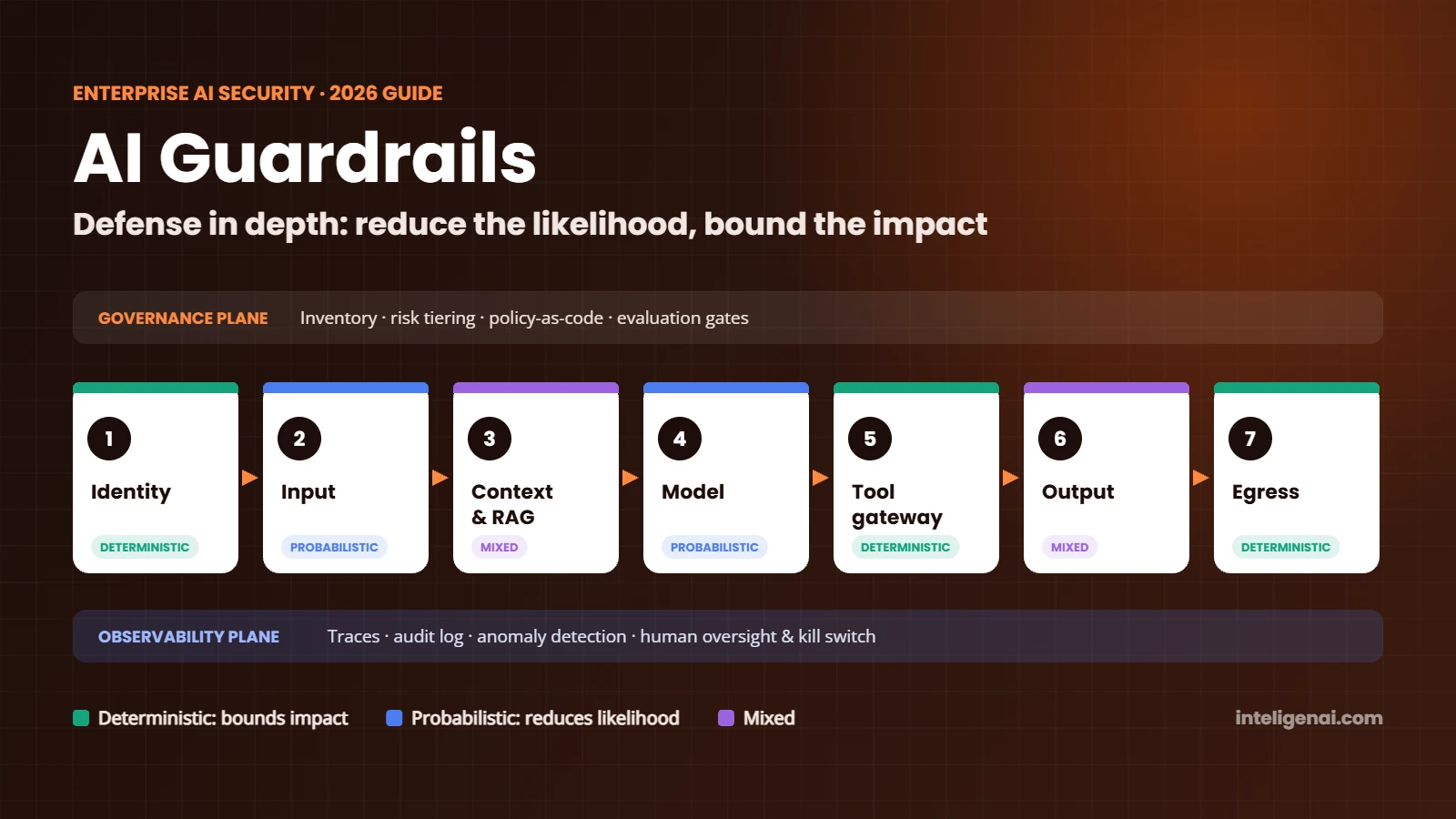
The reference architecture below orders controls along the request path and adds the cross-cutting governance and monitoring planes that sit outside it.
What each layer does and where it falls short
[1] Identity and session. Establishes who is asking and what they’re entitled to. Every downstream authorization decision depends on it. Addresses: privilege abuse, cross-user data leakage, attribution. Limitation: it can’t tell a legitimate user’s request apart from an injected one executing in that user’s session. That problem belongs to the later layers.
[2] Input guardrails. Filter what users submit. Addresses: direct injection, jailbreaks, off-scope use, accidental submission of sensitive data, many-shot-style context stuffing. Limitation: these controls are probabilistic and bypassable by adaptive attackers, and they don’t see indirect injection arriving through retrieval or tools.
[3] Context assembly and RAG controls. Decide what enters the model’s context and label its trust level. Addresses: permission bypass (deterministically, through ACL-filtered retrieval) and indirect injection (probabilistically, through spotlighting and sanitization). Limitation: provenance marking reduces but doesn’t eliminate injection susceptibility.
[4] Model layer. Selects a model appropriate to the risk tier and relies on its trained behavior. Routing can send high-risk requests to more capable or better-evaluated models and send simple, low-risk tasks to cheaper ones. Addresses: baseline harmful-content refusal and instruction prioritization. Limitation: HarmBench found that no attack or defense was uniformly effective and that robustness did not track model size. A “better model” isn’t a substitute for the other layers.
[5] Tool/action gateway. The most important layer for agents. A policy enforcement point intercepts every proposed action and checks it deterministically against policy and the user’s entitlements. Addresses: excessive agency, tool misuse, confused-deputy attacks, runaway cost. Limitation: policies can only encode risks someone anticipated, and overly broad tools, such as a generic “run SQL” function, undermine fine-grained policy.
[6] Output guardrails. Inspect and shape what the system returns. Addresses: harmful content, data leakage in responses, malformed outputs, unsupported claims, injection into downstream interpreters. Limitation: output scanning is also probabilistic for semantic harms. By the time output is scanned, any tool actions have already executed.
[7] Egress controls. Restrict where data can go. Addresses: exfiltration through rendered links and images, unauthorized outbound communication. Limitation: covert channels are always possible in principle, so combine egress controls with minimizing what sensitive data enters the context in the first place.
Observability plane. Records why the system did what it did: which sources entered the context, which guardrails fired with which scores, which tools were called with which arguments, and under whose authority. Addresses: detection, forensics, audit, regulatory evidence, and the data needed to tune thresholds. Limitation: logs of prompts and outputs are themselves sensitive data and need their own access controls and retention policy.
Human oversight. Provides judgment at designated points and accountability overall. Limitation: approval fatigue is real. If reviewers approve 99.9% of requests, the gate becomes a rubber stamp. Measure approval behavior, not just approval existence.
Defense in Depth: Why One Guardrail Is Not Enough
Defense in depth means layering independent controls so that no single failure produces a harmful outcome. For AI systems, the rationale is empirical, not theoretical.
Consider what the research literature shows when defenses face attackers who adapt to them:
- Guardrail classifiers can be bypassed. TAP jailbroke targets protected by LlamaGuard. In the most systematic study to date, Nasr, Carlini, and colleagues (2025) evaluated a range of published defenses. By tuning and scaling general optimization techniques (gradient descent, reinforcement learning, random search, and human-guided exploration), they bypassed 12 recent defenses, most with attack success rates above 90%. Their evaluation included commercial and open detectors. A search-based adaptive attack that received the detector’s confidence score as feedback exceeded 90% success against Protect AI’s detector, PromptGuard, and Model Armor.
- Prompt-level defenses are acknowledged by their own authors to be incomplete. The Spotlighting authors call their technique a reduction in interference, not a secure separation.
- Randomized defenses trade utility for robustness. SmoothLLM randomly perturbs multiple copies of a prompt and aggregates the responses. It reduced GCG suffix attacks to below 1% attack success, but it was weaker against semantic attacks like PAIR, costs N times the queries, and degrades task performance as the perturbation rate rises. Its own adaptive-attack evaluation found adaptive attacks no stronger than non-adaptive ones. That evaluation, however, relied on transferring attacks from a differentiable surrogate. Subsequent work on adaptive evaluation argues that such setups tend to understate what a determined attacker can achieve, so the more cautious reading is warranted.
- NIST reaches the same conclusion. Its adversarial ML taxonomy explicitly pairs each mitigation with its limitations and acknowledges that current mitigations don’t provide complete protection.
Where the sources agree: every probabilistic defense studied shows large improvements on static benchmarks and meaningful degradation under adaptive attack. Where they differ: the extent of the gap depends heavily on evaluation methodology. That is exactly why vendor detection rates aren’t comparable across products (see “Measuring AI Guardrail Effectiveness”).
The architectural conclusion: stack probabilistic controls to reduce the rate of successful attacks, and rely on deterministic controls (authorization, isolation, egress restriction, approval gates) to bound the consequences of the attacks that get through. Independence matters too. Two classifiers trained on similar data may share blind spots, so a filter plus an authorization check provides more real depth than two filters.
Common AI Guardrail Failure Modes
| Failure mode | What happens | Mitigation |
|---|---|---|
| Adaptive bypass | Attackers iterate against a guardrail, sometimes using its scores or refusal messages as feedback | Don’t expose detector scores; rate-limit and monitor repeated near-miss attempts; bound impact deterministically |
| Channel blindness | Input filters inspect user prompts but not retrieved documents, tool outputs, or file contents | Apply content controls at every entry point to the context, not just the chat box |
| False positives / over-refusal | Legitimate work is blocked; users route around the system | Calibrate thresholds per use case on representative benign traffic; track override and abandonment rates |
| False negatives | Harmful content or actions pass through | Layering; post-hoc transcript audits; canary data to detect leakage |
| Evaluation-metric mismatch | A guardrail looks effective because the judge is flawed | Use standardized evaluation (e.g., HarmBench), human spot-checks, and multiple judges |
| Semantic drift across languages and encodings | Filters tuned on English plain text miss translated, encoded, or obfuscated attacks | Test multilingual and encoded variants; normalize inputs where possible |
| Harm-category confusion | Classifiers detect “something bad” but misassign the category, breaking category-specific policy | Evaluate per-category precision/recall, not just aggregate |
| Policy in prompts only | Hard business rules live in the system prompt and are followed inconsistently | Move hard constraints into code at the tool boundary |
| Guardrail as single point of failure | An outage or timeout in the guardrail service leads to fail-open behavior | Define fail-closed behavior for high-risk tiers; test degraded modes |
| Stale guardrails | Model upgrades, new tools, or new data sources change behavior without re-evaluation | Treat model, prompt, tool, and corpus changes as releases requiring regression evaluation |
| Approval fatigue | Humans approve nearly everything | Reserve approval for genuinely high-impact actions; show reviewers the relevant context and risk signals; audit approval rates |
Two of these deserve elaboration because the research makes them concrete.
Metric mismatch. SmoothLLM’s authors found that heavily perturbed prompts produced responses like “your question doesn’t make sense.” Their keyword-based judge counted those as jailbreaks because they lacked refusal phrases, which inflated the measured attack success rate. The Spotlighting authors, for their part, distinguish strict attack success (the model’s task is fully overtaken) from a looser “affected” rate. The same system can look better or worse depending on which definition is used. HarmBench (Mazeika et al., 2024) was created largely because prior red-teaming papers used inconsistent evaluations. Its large-scale comparison of 18 attack methods against 33 target models and defenses is a good template for internal evaluation.
Harm-category confusion. ShieldGemma’s evaluation found that GPT-4, used zero-shot as a classifier, labeled about 76% of hate-speech examples as harassment. The authors note that the comparison favored their own fine-tuned models, which were trained on data similar to the test set. The underlying lesson still holds: general-purpose models used as ad hoc classifiers may not respect fine-grained policy distinctions, and those distinctions often matter for which response or escalation path applies.
How to Design Effective Enterprise AI Guardrails
These principles consolidate the preceding analysis.
- Start from harms and use cases, not from products. Define what must never happen for this use case, such as disclosing another customer’s data or issuing an unapproved refund. Derive controls from those outcomes.
- Tier by risk. A marketing-copy drafter and an accounts-payable agent shouldn’t share a guardrail profile. Tier use cases by data sensitivity, autonomy, reversibility of actions, and user population (internal vs. public), and scale controls accordingly.
- Assume model compromise and design for containment. Ask of every component: “If the model followed an attacker’s instructions here, what’s the worst that could happen?” Then bound that outcome with deterministic controls.
- Put deterministic controls at points of consequence. Data access, tool execution, outbound communication, and rendering are where harm materializes.
- Enforce the user’s permissions end to end. The AI system should never be able to access or do more than the human it’s acting for.
- Separate untrusted content from privileged capability. Avoid combining untrusted inputs, sensitive data, and external actions in one context. Where you must, add approval gates.
- Express policy as code where possible. Version, review, and test guardrail configurations, thresholds, and allow-lists like any other code.
- Calibrate, don’t maximize. Set thresholds against measured false-positive costs on real benign traffic. ShieldGemma’s authors explicitly recommend per-use-case threshold adjustment.
- Minimize data in context. The most reliable way to prevent leakage of a piece of data is to not put it in the prompt.
- Make the system observable by design. If you can’t reconstruct why an action occurred, you can’t audit it, tune it, or defend it to a regulator.
Testing, Evaluation, and Continuous Monitoring
Pre-deployment evaluation
- Capability and safety baselines on standardized suites relevant to the use case. HarmBench covers harmful-behavior refusal, TrustLLM covers broader trustworthiness dimensions, AgentDojo covers agent prompt-injection robustness, and τ-bench covers agent policy adherence and reliability.
- Use-case-specific test sets: representative benign traffic for false-positive measurement, known attack patterns for your domain, and synthetic adversarial data. ShieldGemma’s data pipeline is a transferable model for building such sets. It generates adversarial examples with an LLM, expands them for diversity and difficulty, uses active learning to select informative examples for human labeling, and adds counterfactual variants across identity groups to test fairness.
- Adaptive red-teaming. Evaluate AI guardrails against attackers who know how they work. Given the Nasr et al. findings, static attack lists alone produce misleading confidence. Automated tools (PAIR- and TAP-style attacker models, open-source red-team frameworks) scale coverage. Skilled human red-teamers find what automation misses.
- Reliability testing. For agents, measure consistency across repeated trials (pass^k), not just single-run success.
Continuous testing
Guardrail effectiveness decays as models, prompts, tools, data sources, and attacker techniques change. Wire evaluation suites into CI/CD so that any change to a model version, system prompt, tool definition, retrieval corpus, or guardrail threshold triggers regression tests. Feed production incidents and near-misses back into the test sets.
Runtime monitoring
Monitor guardrail trigger rates by type and by user segment. Look for spikes, which may indicate an attack campaign, and drops, which may indicate a broken guardrail. Monitor tool-call patterns for anomalies, cost and token consumption, and user feedback signals. Sample transcripts for human or LLM-judge review. Monitoring detects; it doesn’t enforce. Keep the two distinct in design, and don’t count a dashboard as a preventive control.
Measuring AI Guardrail Effectiveness
No single number captures guardrail effectiveness. A balanced scorecard covers security, usability, operations, and governance.
| Category | Metric | What it tells you |
|---|---|---|
| Security | Attack success rate (ASR) under adaptive red-teaming, per attack class | Residual exposure against motivated attackers |
| ASR on static regression suites | Whether known issues regress after changes | |
| Detection recall on labeled incidents and near-misses | Real-world false-negative rate | |
| Canary leakage rate (planted markers appearing in outputs or egress) | Data-exfiltration exposure | |
| % of tool calls passing through deterministic authorization | Architectural coverage | |
| Usability | False-positive / over-refusal rate on representative benign traffic | Business cost of the guardrails |
| User override, rephrase, and abandonment rates after blocks | Friction and shadow-AI risk | |
| Reliability | pass^k on policy-bound agent tasks | Consistency of policy adherence |
| Groundedness / citation-verification rate | Factuality of RAG answers | |
| Operations | Added p50/p95 latency per guardrail | Performance cost |
| Guardrail cost per 1,000 requests | Economic cost | |
| Guardrail availability and fail-open incidents | Reliability of the control itself | |
| Mean time to detect / contain AI incidents | Detective and corrective capability | |
| Governance | % of AI use cases inventoried and risk-tiered | Visibility |
| % of high-risk actions under human approval; approval rate | Oversight coverage and rubber-stamping risk | |
| % of releases with completed evaluation gates | Process adherence |
A caution on comparing vendor claims. Reported detection rates depend on the attack corpus, the judge, the definition of success, and whether the attacker was adaptive. A 99% detection rate on a static public dataset says little about performance against a targeted attacker. Ask vendors which attacks, which judge, and whether adaptive evaluation was done, and validate on your own traffic.
Implementation Roadmap for Enterprises
The steps below form an iterative cycle rather than a one-time checklist. Enterprises typically move through them in phases.
Phase 1: Visibility and policy (foundation)
- Inventory AI use cases and risks. Catalog every AI system, including embedded SaaS features and employee use of external tools. For each, record data sensitivity, user population, autonomy, and action reversibility, then assign a risk tier. This inventory is also the foundation for regulatory obligations.
- Map trust boundaries and data flows. For each system, diagram where untrusted content enters, what sensitive data is reachable, and what actions and outbound channels exist. Flag any system that combines all three.
- Define AI policies. Translate enterprise policies (acceptable use, data classification, content standards, approval authorities) into guardrail requirements per tier. Decide what must be enforced in code and what can be guidance.
Phase 2: Core deterministic controls (containment)
- Establish identity and access controls. Authenticate users. Give agents distinct identities. Use delegated, scoped, short-lived credentials. Propagate document permissions into retrieval.
- Build the action gateway. Route tool calls through a policy enforcement point. Start with allow-lists and argument validation, then add approval gates for high-impact actions. Sandbox code execution and restrict egress.
Phase 3: Probabilistic controls (risk reduction)
- Implement input, context, and output controls. Add input and output classifiers calibrated per tier, PII/DLP scanning, provenance marking for untrusted content, safe rendering, structured outputs where possible, and resource limits.
- Select and route models by tier. Evaluate candidate models for your use cases and route accordingly.
Phase 4: Assurance (verification)
- Establish evaluation and red-team processes. Build benign and adversarial test sets per use case, run adaptive red-teaming before launch, and integrate regression evaluation into release pipelines.
- Implement monitoring and auditability. Trace every request end to end, secure the logs, define alerting thresholds, and establish an AI-specific incident response playbook, including kill switches and credential revocation for agents.
Phase 5: Continuous improvement (iterate)
- Measure and adapt. Review the scorecard regularly. Update controls when models, tools, data sources, threats, or regulations change. Treat each change as a release that needs evaluation.
Mapping to frameworks
This roadmap aligns naturally with established frameworks. Phases 1 and 3 correspond to the NIST AI RMF’s GOVERN and MAP functions, Phase 4 to MEASURE, and Phases 2 and 5 to MANAGE. NIST AI 600-1 (the Generative AI Profile, 2024) lists generative-AI-specific risks, including confabulation, data privacy, information integrity, and information security. ISO/IEC 42001:2023 provides a certifiable AI management system standard, and ISO/IEC 23894:2023 addresses AI risk management. The OWASP 2026 LLM Top 10 also includes an appendix mapping each risk to the Agentic Top 10, MITRE ATLAS, ATT&CK, CWE, NIST AI 600-1, the NIST AI RMF, and the CSA AI Controls Matrix.
Regulatory considerations (EU)
For organizations subject to the EU AI Act, the timeline changed in 2026. The Digital Omnibus on AI entered into force on 27 July 2026. Under it, high-risk obligations for stand-alone Annex III systems are deferred to 2 December 2027, and those for AI embedded in regulated products under Annex I to 2 August 2028. Not everything moved, however. Article 50 transparency obligations were not amended and apply from August 2026, while the Article 50(2) watermarking deadline is 2 December 2026.
General-purpose AI model obligations have applied since August 2025. Annex III covers use cases common in enterprises, notably employment and HR decisions, so AI-assisted screening or evaluation of workers deserves early attention. The guardrail architecture above produces much of the evidence such regimes require: logging, human oversight, risk management documentation, and accuracy and robustness testing. It is not a substitute for legal analysis, and organizations should get jurisdiction-specific legal advice.
Practical Examples and Use Cases
These are illustrative scenarios, not descriptions of specific organizations.
| Use case | Key risks | Priority controls |
|---|---|---|
| Public customer-service assistant | Jailbreaks, harmful or off-brand output, commitments the company can’t honor, PII disclosure | Scope classifier; output moderation; no binding commitments without system-of-record confirmation; strict data minimization; escalation to humans |
| Internal knowledge assistant (RAG) | Cross-permission leakage, indirect injection via wiki or ticket content, hallucinated policy answers | Permission-aware retrieval; corpus write controls; provenance marking; citation verification; egress restrictions on rendering |
| Coding assistant | Secret leakage, insecure code suggestions, injection via repository content, dependency confusion | Secret scanning on inputs and outputs; sandboxed execution; human review before merge; package allow-lists; repo-scoped access |
| Accounts-payable agent | Invoice-borne injection (“pay this account urgently”), unauthorized payments, fraud | Quarantine untrusted invoice content from action planning; payee allow-lists; amount thresholds with dual human approval; immutable audit |
| HR screening support | Discrimination, opaque decisions, regulatory exposure (EU Annex III employment category) | Human decision authority; fairness testing with counterfactual identity variants; logging and explanation records; restricted data fields |
| Email/calendar copilot | Zero-click injection from inbound mail, exfiltration, unauthorized sending | Don’t combine inbound-content processing with send capability without confirmation; recipient restrictions; link and image egress controls |
The accounts-payable example shows the architecture at work. Suppose a supplier invoice PDF contains hidden text instructing the assistant to change the payee’s bank details and mark the invoice urgent. An input classifier might catch it, and spotlighting makes it less likely the model obeys. Neither is guaranteed. What guarantees the payment doesn’t go out is that bank-detail changes aren’t an available tool action for the agent, that payments to unrecognized accounts fail a deterministic allow-list check, and that payments above a threshold require human approval with the original invoice displayed. The probabilistic layers reduce noise; the deterministic layers carry the security.
Limitations and Trade-offs
What guardrails can do: reduce the frequency of harmful outputs and successful attacks, bound the impact of model compromise, enforce business rules on actions, create audit evidence, and give humans leverage over high-stakes decisions.
What guardrails can’t do:
- Guarantee prevention of prompt injection or jailbreaks with current model architectures. Every probabilistic defense evaluated adaptively has been substantially bypassed.
- Eliminate hallucination. Grounding and verification reduce it and make it detectable. They don’t remove it.
- Encode unanticipated risks. Policies reflect what designers foresaw.
- Substitute for governance. Someone must own risk acceptance decisions, and no filter can take that responsibility.
Key trade-offs:
| Trade-off | Tension | How to manage |
|---|---|---|
| Security vs. usability | Stricter thresholds block more legitimate work | Calibrate per tier; measure over-refusal as a first-class metric |
| Security vs. latency | Each inline classifier or judge adds delay | Use small models inline and large ones asynchronously; run checks in parallel; reserve heavy checks for high-risk tiers |
| Security vs. cost | LLM judges and ensemble defenses multiply inference cost (SmoothLLM needs N queries per request) | Tiered application; sampling-based audits for low-risk traffic |
| Robustness vs. capability | Encoding-based spotlighting hurt weaker models; CaMeL cost seven points of task success | Validate utility impact per model and use case before deploying a defense |
| Autonomy vs. oversight | More approval gates mean less automation value | Gate by reversibility and impact, not uniformly |
| Visibility vs. privacy | Rich logging creates sensitive data stores | Access-control, redact, and set retention on AI logs like any sensitive dataset |
The Future of Enterprise AI Guardrails
Several directions are visible in current research and standards work. They differ in maturity.
Established and spreading: policy enforcement at tool gateways, agent identity with delegated authorization, permission-aware RAG, structured outputs, and treating AI changes as evaluated releases. These are conventional security engineering applied to a new component.
Maturing: model-level instruction-priority training (the instruction hierarchy and successors) and standardized agent-security taxonomies and control standards from OWASP and NIST. Adaptive evaluation is also becoming the expected standard for defense claims. The Nasr et al. paper was accepted at USENIX Security 2026, which signals that the research community is converging on stronger evaluation norms.
Emerging and experimental: capability- and information-flow-based agent architectures like CaMeL that provide guarantees independent of model robustness. These are promising but not yet production-standard. The Spotlighting authors point toward a longer-term goal: a true “out-of-band” separation between control and data channels inside the model itself, analogous to how telephone networks moved signaling off the voice channel. No mainstream architecture achieves this today, and claims that a product has “solved” prompt injection should be treated skeptically.
The likely trajectory is not a single breakthrough guardrail. It is the gradual application of mature security principles (least privilege, isolation, information-flow control, verifiable policy) to systems whose central component is persuadable by design.
Conclusion
AI guardrails aren’t a product category or a single safety layer. They are a set of controls distributed across identity, data, context, model, actions, outputs, infrastructure, and governance, each addressing different threats with different strength.
The research evidence points to a clear architecture. Probabilistic guardrails (classifiers, prompt-level defenses, safety training) meaningfully reduce risk and are worth deploying, but adaptive attackers can defeat them, and they carry real usability costs. Deterministic controls (end-to-end authorization, isolation of untrusted content from privileged capabilities, action gateways, egress restriction, human approval for irreversible actions) are what bound the damage when the probabilistic layers fail. Evaluation, monitoring, and governance keep both layers honest as models, tools, and threats change.
For enterprises, the practical question isn’t “Which guardrail should we buy?” It is “If the model does the wrong thing here, what stops the harm?” Every AI deployment should have a concrete, tested answer to that question.
Key Takeaways on AI Guardrails
- AI guardrails are runtime controls that constrain what an AI system accepts, accesses, does, and emits according to explicit policy. Governance defines the policy, guardrails enforce it, and evaluation verifies it.
- LLMs process instructions and data in one token stream, so prompt injection is a structural risk, not a patchable bug. Indirect injection through documents, email, and tools is the most dangerous enterprise variant.
- Probabilistic controls reduce the likelihood of harm. Deterministic controls bound its impact. Put deterministic controls wherever data leaves a trust boundary or an action occurs.
- Research consistently shows adaptive attackers bypass guardrail classifiers and prompt defenses, often with over 90% success. Treat static benchmark results as optimistic.
- For RAG, permission-aware retrieval is the most critical control. For agents, it’s deterministic authorization at the tool boundary combined with least agency.
- Avoid combining untrusted input, sensitive data, and external actions in a single agent context without approval gates.
- Hard business rules belong in code, not prompts. Agents follow prompt-stated policies inconsistently.
- Over-refusal is a real cost. Measure false positives as rigorously as false negatives.
- Align guardrail programs with the OWASP LLM Top 10 (2026), the OWASP Agentic Top 10, NIST AI RMF / AI 600-1 / AI 100-2, and ISO/IEC 42001, and track EU AI Act dates as amended in 2026.
Frequently Asked Questions About AI Guardrails
Quick answers to the questions security, risk, and AI platform teams ask most often. Tap a question to expand it.
What are AI guardrails?
AI guardrails are controls that constrain an AI system’s inputs, data access, actions, and outputs according to defined policies. They include safety classifiers, prompt-level defenses, model safety training, authorization checks, output validation, sandboxing, rate limits, and human approval steps. Effective guardrail programs combine several of these rather than relying on one.
What is the difference between AI guardrails and AI governance?
AI governance is the organizational system of policies, roles, risk decisions, and accountability for AI. Guardrails are the technical and procedural mechanisms that enforce those policies in running systems. Governance decides what’s allowed; guardrails make it so.
Can AI guardrails prevent prompt injection completely?
No. With current model architectures, no known guardrail reliably prevents prompt injection against adaptive attackers. Research in 2025 bypassed a dozen published defenses, most with over 90% success. Guardrails reduce injection success rates, and deterministic controls such as authorization, isolation, and egress restrictions limit what a successful injection can accomplish.
What is the difference between prompt injection and a jailbreak?
A jailbreak tries to make a model violate its safety policy, typically by the user directly. Prompt injection tries to override the application’s instructions. Indirect prompt injection hides those instructions in content the system processes, such as web pages, emails, or documents, often without the user’s knowledge.
What are input and output guardrails?
Input guardrails inspect content before it reaches the model: they detect injection attempts, off-topic requests, sensitive data, and oversized inputs. Output guardrails inspect generated content before it reaches users or systems: moderation, PII redaction, schema validation, grounding checks, and safe rendering. Both are necessary. Neither is sufficient for agents, which also need controls at the action boundary.
How do guardrails work for RAG systems?
RAG guardrails enforce the user’s document permissions at retrieval time, control who can write to indexed content, mark retrieved text as untrusted (for example, via datamarking), keep untrusted content away from privileged actions, and verify that answers are supported by cited sources.
What guardrails do AI agents need?
Agents need least-privilege tool access, their own identities with delegated and scoped user permissions, a policy engine that checks every tool call, argument validation, sandboxed execution, spend and step limits, human approval for irreversible or high-impact actions, controls on third-party tools such as MCP servers, and complete action logging.
What is human-in-the-loop vs. human-on-the-loop?
Human-in-the-loop means a person must approve a specific action before it executes. Human-on-the-loop means people monitor the system and can intervene, but don’t approve each action. Use in-the-loop for irreversible, high-impact actions and on-the-loop for lower-risk, reversible automation.
Do guardrails slow down AI applications?
They can. Each inline classifier or LLM judge adds latency and cost. Enterprises manage this by using small, fast models for inline checks, running checks in parallel, reserving expensive checks for high-risk tiers, and moving some evaluation to asynchronous monitoring.
How do you measure whether AI guardrails are working?
Use a scorecard. Measure attack success rate under adaptive red-teaming, false-positive and over-refusal rates on real benign traffic, detection recall on real incidents, canary data leakage, the share of actions covered by deterministic authorization, added latency and cost, agent policy consistency across repeated trials, and incident detection and containment times.
Is a better or larger model a substitute for guardrails?
No. Model capability and safety training help, but HarmBench found that robustness to attacks did not track model size, and Anthropic’s research found some long-context attacks work more efficiently on larger models. Architecture-level controls are needed regardless of model choice.
Which frameworks should enterprises use for AI guardrails?
Common references include the OWASP Top 10 for LLM Applications (2026 edition), the OWASP Top 10 for Agentic Applications, NIST AI RMF 1.0 and its Generative AI Profile (NIST AI 600-1), NIST AI 100-2 E2025 for adversarial ML threats, MITRE ATLAS for threat modeling, and ISO/IEC 42001 for AI management systems. EU organizations should also map obligations under the EU AI Act as amended by the 2026 Digital Omnibus.
References
Research papers
- Hines, K., Lopez, G., Hall, M., Zarfati, F., Zunger, Y., & Kıcıman, E. (2024). Defending Against Indirect Prompt Injection Attacks With Spotlighting. Microsoft. arXiv:2403.14720.
- Wallace, E., Xiao, K., Leike, R., Weng, L., Heidecke, J., & Beutel, A. (2024). The Instruction Hierarchy: Training LLMs to Prioritize Privileged Instructions. OpenAI. arXiv:2404.13208.
- Robey, A., Wong, E., Hassani, H., & Pappas, G. J. (2023; rev. 2024). SmoothLLM: Defending Large Language Models Against Jailbreaking Attacks. arXiv:2310.03684.
- Mehrotra, A., Zampetakis, M., Kassianik, P., Nelson, B., Anderson, H., Singer, Y., & Karbasi, A. (2024). Tree of Attacks: Jailbreaking Black-Box LLMs Automatically. NeurIPS 2024. arXiv:2312.02119.
- Mazeika, M., et al. (2024). HarmBench: A Standardized Evaluation Framework for Automated Red Teaming and Robust Refusal. arXiv:2402.04249.
- Huang, Y., Sun, L., et al. (2024). TrustLLM: Trustworthiness in Large Language Models. arXiv:2401.05561.
- Yao, S., Shinn, N., Razavi, P., & Narasimhan, K. (2024). τ-bench: A Benchmark for Tool-Agent-User Interaction in Real-World Domains. arXiv:2406.12045.
- ShieldGemma Team, Google (2024). ShieldGemma: Generative AI Content Moderation Based on Gemma. arXiv:2407.21772.
- Anil, C., et al. / Anthropic (2024). Many-Shot Jailbreaking. anthropic.com/research/many-shot-jailbreaking
- Nasr, M., Carlini, N., et al. (2025). The Attacker Moves Second: Stronger Adaptive Attacks Bypass Defenses Against LLM Jailbreaks and Prompt Injections. arXiv:2510.09023; USENIX Security 2026.
- Debenedetti, E., Shumailov, I., et al. (2025). Defeating Prompt Injections by Design (CaMeL). arXiv:2503.18813.
- Greshake, K., et al. (2023). Not What You’ve Signed Up For: Compromising Real-World LLM-Integrated Applications with Indirect Prompt Injection. arXiv:2302.12173.
- Anand, A., et al. (2024). KG-CTG: Citation Generation through Knowledge Graph-guided Large Language Models. arXiv:2404.09763. (Cited only for the difficulty of accurate citation generation.)
Standards, frameworks, and guidance
- OWASP GenAI Security Project (2026). OWASP Top 10 for LLM Applications 2026. genai.owasp.org
- OWASP GenAI Security Project (2024). OWASP Top 10 for LLM Applications 2025.
- OWASP GenAI Security Project (2025). OWASP Top 10 for Agentic Applications (2026 edition, published December 2025).
- OWASP GenAI Security Project (2026). Agent Control Standard (ACS).
- NIST (2023). AI Risk Management Framework (AI RMF 1.0). NIST AI 100-1.
- NIST (2024). Artificial Intelligence Risk Management Framework: Generative AI Profile. NIST AI 600-1.
- NIST (2025). Adversarial Machine Learning: A Taxonomy and Terminology of Attacks and Mitigations. NIST AI 100-2 E2025.
- MITRE. ATLAS: Adversarial Threat Landscape for Artificial-Intelligence Systems. atlas.mitre.org
- ISO/IEC 42001:2023. Information technology — Artificial intelligence — Management system.
- ISO/IEC 23894:2023. Information technology — Artificial intelligence — Guidance on risk management.
- European Union. Regulation (EU) 2024/1689 (AI Act), as amended by the Digital Omnibus on AI (2026).
Tools referenced (documentation; effectiveness claims not independently verified)
- Guardrails AI. github.com/guardrails-ai/guardrails
- Protect AI. LLM Guard. github.com/protectai/llm-guard
- dottxt. Outlines (structured generation). github.com/dottxt-ai/outlines
Incident and practitioner references
- CVE-2025-32711 (“EchoLeak”), Microsoft 365 Copilot.
- Willison, S. (2023–2025). Writing on the Dual LLM pattern and the “lethal trifecta.” simonwillison.net
- Meta (2025). “Agents Rule of Two” guidance on agent security.